
Showing posts with label Berlin. Show all posts

Ten Steps to Organise a Community Project

 Are you visiting this post for inspiration and guidance for your own community group or project?  Are you inspired by an issue or looking to create an interest group around permaculture?  Here are ten steps to get you started.

Click Here to Read More About Community Organizations

The Ten Steps to Organize a Community Project

  1. To begin you need to have something to organize around. This might be a service or a goal. For example organizing a community permaculture group or fighting to save your local public transportation from oblivion. Luckily, many issues are not just national but also global and so a bit of research can turn up national or international organization with active networks and a working model to follow, just make sure they are grassroots.
  2. Next you must get out there. Meet other people with the same interests. You will likely find an already established network of people or even better, an already established community group. This could be at a town meeting, an online forum, your child's school, or anyplace where there might be action around your interest.
  3.  If no such thing exists, go simple and create a virtual space on Facebook or other forum. All you really need to start a functioning group is three people or so. 
  4. You then begin by creating, in order of priority, goals. You should have an ultimate long term goal as well as smaller intermediate goals to achieve your objective. 
  5. Now you put the work in! find a place to meet, start seedlings or create an informative leaflet about your bus system and go on the streets. A table on the sidewalk or at a farmers market is a perfect place to start. 
  6. Keep your routine up! sometimes it takes people a few weeks between hearing about your meetings and showing up. You  must have meetings every week or fortnight even if they are small and short and even if they are still only online. In my experience once a month is not often enough, members forget its going on.  Its no good to ditch a meeting just because you think no one new will be there. If a new member does show up, but there is no meeting there, than you have lost a member and their networks.
  7. Alternatively, if you are swamped with new members make sure your organization keeps to its agenda. It is easy for an organization to get hijacked or pulled into five different directions when it grows too quickly. There is nothing wrong with organizations maintaining their original intention even if it means losing a few members.
  8. How you are going to fund raise is the next challenge. If your group can organize a moneyless operation perfect, that is always a goal of mine. If not, membership dues or fundraising events need to be planned. Remember Autonomy is key, do not become dependent on outside organizations giving regular contributions, especially if they are government, businesses or political organizations.
  9. As the members begin to come your goals and methods need to be reassessed to include the wishes and opinions of new members. If new members aren't joining then keep on going, it can take a while, sometimes years. Just make sure you are as active as you can be without burning yourselves out. 
  10. Remember to be Democratic! Organizations often split over important differences in either their goals or methods. Even if they have separated they can still work together on issues they agree about without losing their integrity. I consider it a growing pain. If your organization has one or two splits, it means you have matured to refined your goals or strategy. And remember grassroots organizing is democratic and doing things democratically with a decent majority agreeing can amount to a lot of debating and deliberation and consequently a lot of time talking when you might prefer action. Ah well! that's just how it goes, Ive never seen a way around it, it may try your patience but that just the democratic process at work.
I hope this helps! please leave a comment if you have any suggestions, tips of your own or links to good grassroots organizations.

Links to Great Community Projects:

Website and online network: Free Cycle
The Freecycle Network™ is made up of 5,035 groups with 8,917,299 members around the world. It's a grassroots and entirely nonprofit movement of people who are giving (and getting) stuff for free in their own towns. It's all about reuse and keeping good stuff out of landfills.
  
Wikipedia: Give-away shops, swap shops, freeshops, or free stores 
The free store is a form of constructive direct action that provides a shopping alternative to a monetary framework, allowing people to exchange goods and services outside of a money-based economy.

Website: Transition Valley Aotearoa NZ
This website is a small aspect of the work which is going on all over the country, as people begin to understand the importance of acting now to mitigate the effects of some of the most direct impacts of peak oil and climate change.

Wikipedia: Critical Mass Movement
Critical Mass is a cycling event typically held on the last Friday of every month in over 300 cities around the world.


Resources:

Website: Did You Say Free Shop? Otago Daily Times News Article
Website: Free Trade Flourishes. Otago Daily Times News Article
Website: Adventurous rat stows away in Donation Otago Daily Times News Article
Facebook Page: Free Shop Dunedin
Website: BBC Arguments against Charity
Website: Dunedin Volunteers Start DIY Bike Workshop. Otago Daily Times News Article
Facebook Page: The Crooked Spoke Bike Workshop

Community Projects and Permaculture Why Charity is not Sustainable

Anyone who practices permaculture, sustainability or is a political activist comes across a good few community projects. I Emphasize that these projects are not charities. What separates these organizations from charities is that they organize to fulfill a need for the community and have nothing to do with whim and generosity for their continuation. These are groups of people who come together to make their goals a reality. There are as many community projects as there are problems and  unlimited ways of organizing. This blog post is about their function politically, their role in urban permaculture. I will mostly use examples from groups in Dunedin, NZ.

Click here for my post on creating your own community group


What is a Community Group? The Difference Between a Charity and a Community Organization 

"It is more socially injurious for the millionaire to spend his surplus wealth in charity than in luxury. For by spending it on luxury, he chiefly injures himself and his immediate circle, but by spending it in charity he inflicts a graver injury upon society. For every act of charity, applied to heal suffering arising from defective arrangements of society, serves to weaken the personal springs of social reform, alike by the 'miraculous' relief it brings to the individual 'case' that is relieved, and by the softening influence it exercises on the hearts and heads of those who witness it. It substitutes the idea and the desire of individual reform for those of social reform, and so weakens the capacity for collective self-help in society. -J A Hobson, Work and Wealth, 1914"
  
This quote is great. It eloquently sums up the fundamental problem with charity. If you wanted to look into it even more you will find many scandals and critiques of individual charities that illustrate the systemic incompatibilities between charity and social gains, but I find that a distraction from real organizing.  A community group is an organization which is organized and maintained by those who use and need it. It may be a service like free shop, a toy library, a food growing cooperative and also includes activist groups, support groups and general interest groups alike. Not all community groups are free, they may do fundraisers or have membership dues, but they are independent and self determining. Some community organizations may find themselves acting charitable from time to time as well, for example, free shop got a good few visits after the Christchurch earthquakes. But this was a natural disaster and the organizers, while happy to help out, did not have any intention of relief work at the outset. The members of the organization decide what is done and how, they are not passive recipients of what they need from a foreign organization based on random generosity or worse, pity. They are also not deciding on what third party receives the fruits of their efforts. In my opinion there is nothing more politically empowering than community organizing and nothing less empowering than receiving charity.

 Community Projects, Community Organizations, Community Groups and Grassroots Organizing

These terms are often interchangeable but can hold specific meanings. Community projects are more synonymous with free shop or toy libraries while community organizations often refer to smaller institutions like rape crisis centers or food shelters. Community groups are often less specific and come together to fight for or against public policy or speak out about local issues. Often a community group does two or all of these things and often in cooperation with other community groups in the area or nationally. What separates these organizations from NGO's as they are typically perceived, is that they are smaller, democratic, and in cases where there is a national group that breaks down into local chapters, the local chapters have autonomy financially and in decision making. This type of organizing is often called Grassroots because the power of decision making comes from the very bottom, its members, and not from the bureaucratic levels.

Permaculture and Community Groups

 I believe that Fundamentally, all progressive change comes out of community organizing and that community projects strengthen a community and equips it to fight for their interests. To have a sustainable society, a lot of progressive change needs to happen. Grassroots organizing teaches people activist skills and tactics as well as providing working alternatives for this change to be modeled on.  More specifically, community groups can be based around permaculture, gardening, food growing, handicrafts, home repair and tool sharing. Ride shares are common as well. Many organizations are based around preserving indigenous knowledge as well as breaking down racist, sexist and homophobic barriers within communities. Grassroots organizing creates a space for people to meet their neighbors and network with other people to form mutually beneficial arrangements and also just to make friends and socialize. Some specific organizations in Dunedin, NZ that work with permaculture ideas are Transition valley (creating a more sustainable community), Critical mass (promotes the use of bicycles as transportation) and Oooby (Out of our own backyards, local food growing). Their websites are listed under the references at the bottom of the page. Frankly, I believe that community groups are a fundamental part of any democracy whether environmentally sustainable or not and permaculture is no exception.


Links to Great Community Projects:

Website and online network: Free Cycle
The Freecycle Network™ is made up of 5,035 groups with 8,917,299 members around the world. It's a grassroots and entirely nonprofit movement of people who are giving (and getting) stuff for free in their own towns. It's all about reuse and keeping good stuff out of landfills.
  
Wikipedia: Give-away shops, swap shops, freeshops, or free stores 
The free store is a form of constructive direct action that provides a shopping alternative to a monetary framework, allowing people to exchange goods and services outside of a money-based economy.

Website: Transition Valley Aotearoa NZ
This website is a small aspect of the work which is going on all over the country, as people begin to understand the importance of acting now to mitigate the effects of some of the most direct impacts of peak oil and climate change.

Wikipedia: Critical Mass Movement
Critical Mass is a cycling event typically held on the last Friday of every month in over 300 cities around the world.


Resources:

Website: Did You Say Free Shop? Otago Daily Times News Article
Website: Free Trade Flourishes. Otago Daily Times News Article
Website: Adventurous rat stows away in Donation Otago Daily Times News Article
Facebook Page: Free Shop Dunedin
Website: BBC Arguments against Charity
Website: Dunedin Volunteers Start DIY Bike Workshop. Otago Daily Times News Article
Facebook Page: The Crooked Spoke Bike Workshop
The Ecology of Ivy


Ivy Araliaceae Hedera helix

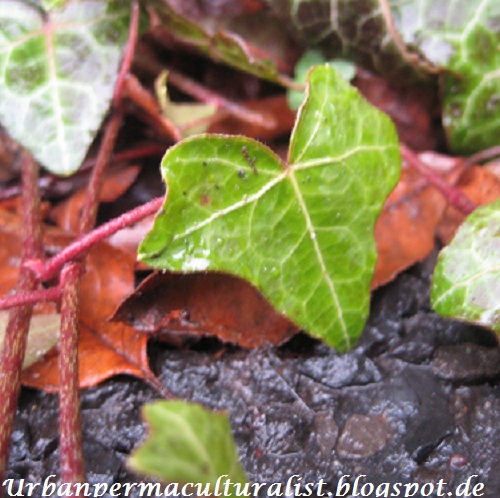
young Ivy leafThere are a few different species of Ivy I am referring to but as they are very, very hard to tell apart and because their ecology and growth habits are the same I am referring to English Ivy, Irish Ivy, Atlantic Ivy and Common Ivy as the same plant. This plant might be commonplace and seem rather uninteresting but it is also a plant of huge ecological importance and due to limited natural habitat, this is even more true in cities. Ivy is native to Europe and is Britain's only native evergreen shrub. It is shade tolerant and grows as both a ground cover and as a creeping vine. When Ivy grows vertically it matures and forms different leaf shapes and flowers. The juvenile plant has the characteristic pointed leaves where the adult vine has more plain looking oval leaves. It has a good tolerance to shade and can grow where many other plants cannot, like a shaded forest floor. Contrary to what many think, Ivy does not damage the trees which it is growing on. The roots do not choke the trunk and Ivy generally does not smother trees unless they are already stressed.  A healthy tree would shade out ivy enough to keep its growth in check. With the exception of Ash trees, which have an open canopy.

purple Ivy berriesWhat makes this plant so special is its fruiting period, winter. Ivy produces purple berries in the winter months when there is little else for wildlife to eat. It is also evergreen and so provides year round habitat for small mammals. It is a particularly important habitat for bats, which roost in the adult foliage. Birds also build their nests in it. The pollen and nectar is a food source in fall for birds, wasps, butterflies and other invertebrates. Ivy is the primary food source for the aptly named Ivy Bee (Colletes hederae) which feeds almost exclusively on Ivy nectar. This bee which was recently discovered in England is now know to have a range across Europe. The foliage covers the forest floor and provides shelter from freezing and hard rains and  snow. And so, it is a winter feeding site for bug eating birds and a shelter for small mammals. The berries are a winter food source for many birds like wood pigeons, starlings, thrushes and blackcaps and are high in fat.

Ivy growing up a flagpoleAlso this vine is great for filtering the air and is shade tolerant. It can grow up walls in spaces where trees cannot and is good for reducing noise pollution and insulating walls. In fact, it is so well adapted to urban environments that you can find it growing in the most unnatural settings like this metal flagpole. One danger ivy can cause when growing in trees is that it can make the tree top heavy and fall over during storms. Ivy is not damaging to most homes when grown up an exterior wall. If removed though, it may take some of the wall with it. It actually protects exterior walls from UV light and graffiti. If grown on a wooden fence or a home with wooden exterior it can often damage it as wood warps with time and changes shape  allowing Ivy the opportunity to grow between the shingles and fencing. Ivy, if given time will completely topple over wooden fencing.

In conclusion, Ivy is a practical plant to grow for wildlife conservation and a cleaner and a more sustainable city. It is also at home in a city and will flourish in some of the harsher environments where other plants cannot grow. I would love to see more buildings covered in vines.


Resources:
Ivy Bee fact sheet PDF at www.bwars.com
Ivy Friend or Foe at ArborEcology.co.uk
Hedera helix L. and H. hibernica (Kirchner) Bean (Araliaceae) in the British Isles at BSBI Archive

Snowberry Symphoricarpos albus

berries of Snowberry Symphoricarpos albusbush of Snowberry Symphoricarpos albusWalking through Berlin you see this shrub again and again. It is planted in gardens and roadsides because of its high tolerance to the stresses of the climate and of the city like pollution and road salt. It is a North American native plant with two closely related species on the east and west coasts. I had never seen this plant before in Philadelphia and upon researching, it is endangered or threatened along much of the Northeast. It is a shrub about human height with opposite leaves and pink flowers in mid summer. In the fall it looses its leaves and forms white berries that are sometimes pink in hybrid cultivars. The berries have a brown stain on the end where the flower was attached. In North America the ecological role of this shrub was to colonize a variety of soil types and in all stages of succession. It grows in patches or stands and its leaves have an average nutrition consisting of low fat and protein levels. It was fed upon by deer, wild sheep and cattle. The bush itself was shelter for small mammals and the berries may have been a source of food for birds, though not a preferred source. Some Native American peoples used the berry as a wash because it forms a lather and some used it to cure stomach upsets. The berries contain saponins, a bitter chemical, but if cooked the saponin is removed though the fruit is very bland. Its Ecology in Berlin is not well researched, but as it is a habitat to small mammals it may harbor rats or squirrels and I have seen that house sparrows enjoy gathering on the shrub, though I am not sure whether they eat the berries or not.One site mentioned that rabbits eat the bark of the plant. It is not classified as invasive in Germany because it is restricted to the locality it was planted in by its growth habits. Because of its widespread planting and its method of vegetative reproduction, I wonder if in the future this plant could become invasive and intrude in natural spaces outside of the city. It is known that this plant blocks light and may impede forest regrowth. It may be the case that this plant naturalizes without a major disruption to the native forest.  This is not a plant I would use for food or wildlife gardening, unless I were still in the North East of the U.S.


References:


How To Make a Portable Forest Garden using Containers

There are many reasons people turn to container gardening. Perhaps you have no bare ground at your flat. Maybe, the landlord does not want you to dig up a lawn or disturb the ornamental plants growing in the beds. Maybe, like me, you move once a year or so and growing perennials would be a waste of time otherwise. Sometimes, like in the case of tomatoes, its your best bet to grow in containers and catch all the sun you can in the short growing season. Whatever your reasons its pretty simple to apply permaculture theory to container gardening.

Quick Jump to sections of this post:

The container:

Any container will work if you make sure there is enough drainage at the bottom. Some plants like wet soils, others moist still others like it on the dry side. Look it up once you've picked your plant. Help the soil drain by putting gravel or broken ceramic at the bottom. If it likes moist to wet soils, chuck some mulch or compost at the bottom. I prefer 20 liter buckets because that is as big as I can carry around. If you don't plan on moving the container the bigger the better (means more plants and bigger roots). If your container is a dark color, like black, you might want to paint it a lighter color unless you live in a cool climate. I have grown annuals in tires, but usually with access to soil underneath. Tires work well for my winter veggies, but my summer crops have suffered and bolted to seed on a few occasions. I like them for potatoes because they are stack able, but slugs also like to hide in them. I let weeds grow around them so they're not so hot in the hottest part of the summer (pretty short part of the Dunedin summer).

The plants:

What plants you choose depends on your preferences but also whether the container is a suitable size.  Perennials can have deep roots so you should pick one thats roots will fit in the container with some spare room. If you pick a larger plant like an apple tree, or bush like a fuchsia you will need to trim back the tops and the roots. How often you do that depends on how fast it grows in your climate. I get away with doing it once a year. If you pick smaller plants you won't have to trim them back as often. If you're growing an herb like mint, it will fill the whole of the container in a year or less. I take out half of it every year or six months depending on how warm the weather has been.

After you have chosen the perennial you can pick its companion plants. I always opt for white clover. None of my plants, even my apple that has shallow roots minds the clover in there.  I also plant small cloves of garlic and shallots I cant be bothered peeling into the containers. I pull them out before they go to seed (except for one or two so I can save some seeds), level it out with some compost and let the clover grow over the spot. Beans have bigger roots and only really do well in a few of my containers. ( It may have as much to do with the different soils as it does with its companions). I wouldn't put herbs in with them unless the container has a really wide diameter and make sure they are not shading the perennial while its young. Kitchen herbs can get big. Basil by itself warrants it's own container. Parsley can grow over a foot tall. I've seen those pots that have tons of little herbs growing together in one pot. Each plant is so small that it provides only one or two meals worth of herbs. Maybe its just me, but I use herbs in handfuls not tablespoons.  Make sure that you don't have more than one or two large rooted plants in the same container unless their roots are compatible shapes (eg. shallow root system in the same pot as a tap root. tomatoes and carrots). Showy flowering plants always improve a container. Clover, nasturtium or marigolds are good examples. These keep bees interested and cover the top of the container so weeds don't take over. Why not go for ones that are edible too?

Growing Tomatoes:

Many Dunedinites are forced to grow tomatoes in containers.  In fall, you can trim tomatoes down to one small leader at the base and bring it indoors(by a window. Don't let the plant get more than a foot tall and keep trimmed back until spring. Allow a few leaders to develop at the base 2/3 of the way through winter they grow really slowly over the winter). This way they start earlier the next season and unlike seedlings, don't waste time developing roots. The Brandywines that I grew that way live for 3 years before developing moldy leaf diseases of several varieties in the third winter. I started over with new plants this spring. Alternatively you could root some laterals from a plant that is doing well and allow their roots to develop over winter indoors. All cherry tomatoes from now on in my garden (not a long enough growing season here unless you have a warm green house). I only managed three or four tomatoes from each plant(trained as two leaders grown to four feet). The remaining fruit were mealy and bland from the cold autumn.

Click here for more on growing tomatoes

The Soil:

The soil you want depends entirely on what plants are going to grow in the container. Outdoor potting soil is best because its pest free, friable and usually has moisture retaining material in it. The drawback is its price tag, not to mention its hard to lug home (pedestrian). Personally, I use soil from the garden (it's free and just outside my door). I break it up with a shovel and discard the bugs, rocks and twigs.  I  mix in some compost and things that the plant might appreciate like sand, compost, leaf litter, etc.. Its important to fertilize them when you've had a few days of rain and to put compost on the top every so often (depending on how fast it breaks down). Every 2 or three months while its growing and a good heap before the plant lays dormant over the winter outside. Sometimes if it gets a bit full, I scoop out the older compost on top and put in fresh compost. When I trim back the roots I put fresh soil back into the pot around the root ball.

Where to Place Your Container:

Usually a sunny spot, sheltered from wind if you can. It really depends on the plant's needs, mostly its required hours of sunlight. Place it somewhere the rain can water it so you don't have to. You still need to water it if its been dry and hot for a few days and you can put it in a shady spot if your going away for a weekend in the summer.  Some of my plants come inside for the winter, the rest go somewhere out of the cold rain so they don't get moldy leaf diseases (especially mint). Some plants you can cut back and stick in the laundry room or under an overhang remembering to water as little as once a week until they come out of dormancy. (Depends on the plant and your climate). Really, it depends on the micro-climates you have around your yard and house. If you've got the right conditions for a certain plant, it may keep growing year round here. Look around, if you see a spot that mimics its natural niche put it there. I generally put them all in the sunniest spot in the summer and break them up in the winter depending on how sensitive they are to cold. If you live in a climate with a hot summer, putting them on a windswept sunny deck might burn leaves or dry a plant out in an afternoon.

You can bury pots if you prefer not to worry about them getting too hot and dry (and your landlord does not mind the bare patches on the lawn). Not being raised above the ground, their roots will not get as hot and not dry out as quickly. I like mine higher up so I don't have to bend down to notice things like weeds to pick out. It all sounds confusing but if you take a walk around your garden once a season it should be easy to find the best spot. If you want to make it  even easier, then write the plant's growing requirements on the container itself with a permanent marker. Note its light needs in hours per day, water needs as moist or dry, and what date it needs to be fertilized and trimmed back.

Urban Permaculturalist Homepage

Welcome to my blog Urban Permaculturalist!

Hello I am a 25 year old graduate of Geography and Ecology From University of Otago in New Zealand (BSC). (Where some of the earlier posts are based on) I am originally from Philadelphia, PA USA  and Currently reside in Berlin with my Partner, a Landscaper with ambitions to homestead. I was inspired to study ecology from the abundant animal and plant life in Philadelphia which lived there despite the pollution and human environment.

My goal with this blog is to write about the urban ecology of Berlin and to look at the sustainability efforts of the people living here. For myself, this will look at sustainability as an apartment dweller in particular. I have a keen focus on Permaculture, a philosophy that I believe can improve and preserve the environment. This site will be a collection of things I have seen or been a part of as well as the ideas and work of others online and in the city.

Check out the navigation bar to the right and browse through the posts I have written! All comments are appreciated and you are welcome to leave a link to your own blog.   

Here is some background on Berlin relevant to the topics in this blog. It is the capital of Germany as well as the largest city with a population of 4.4 million people in the greater area. The Climate is temperate and seasonal. It has mild winters and warm summers with little extreme weather. The climate in Berlin is comparable to these other cities Den Bosch, Seattle, London, Dunedin and Portland. It is obvious walking around that there is much green space in the city as well as opportunities to "green" the city. Around one third of the city is covered with parks, rivers, lakes, gardens and forest. Berlin has much wildlife already in the city to meet and a host of new plants I have not seen in North America. I am excited to explore my new home in Berlin!

Sources of Information
 http://en.wikipedia.org/wiki/Berlin
 http://traveltips.usatoday.com/den-bosch-climate-weather-21037.html

Subscribe To Urban Permaculturalist
You can subscribe to this blog! New content will be sent to your inbox from the "Subscribe by email"  under the comments on the individual posts.  The in text link above (in quotes) is an active link where you can subscribe as well.